Assisted living vs. memory care: which does my parent need?
Assisted living usually works when a parent has mild memory loss but stays safe and can find their way around. A secured memory care setting is needed when wandering, exit-seeking, or 24-hour safety needs take over. In Louisiana, memory care is a secured dementia unit inside assisted living, not a separate license. As of 2025, it costs a little more.
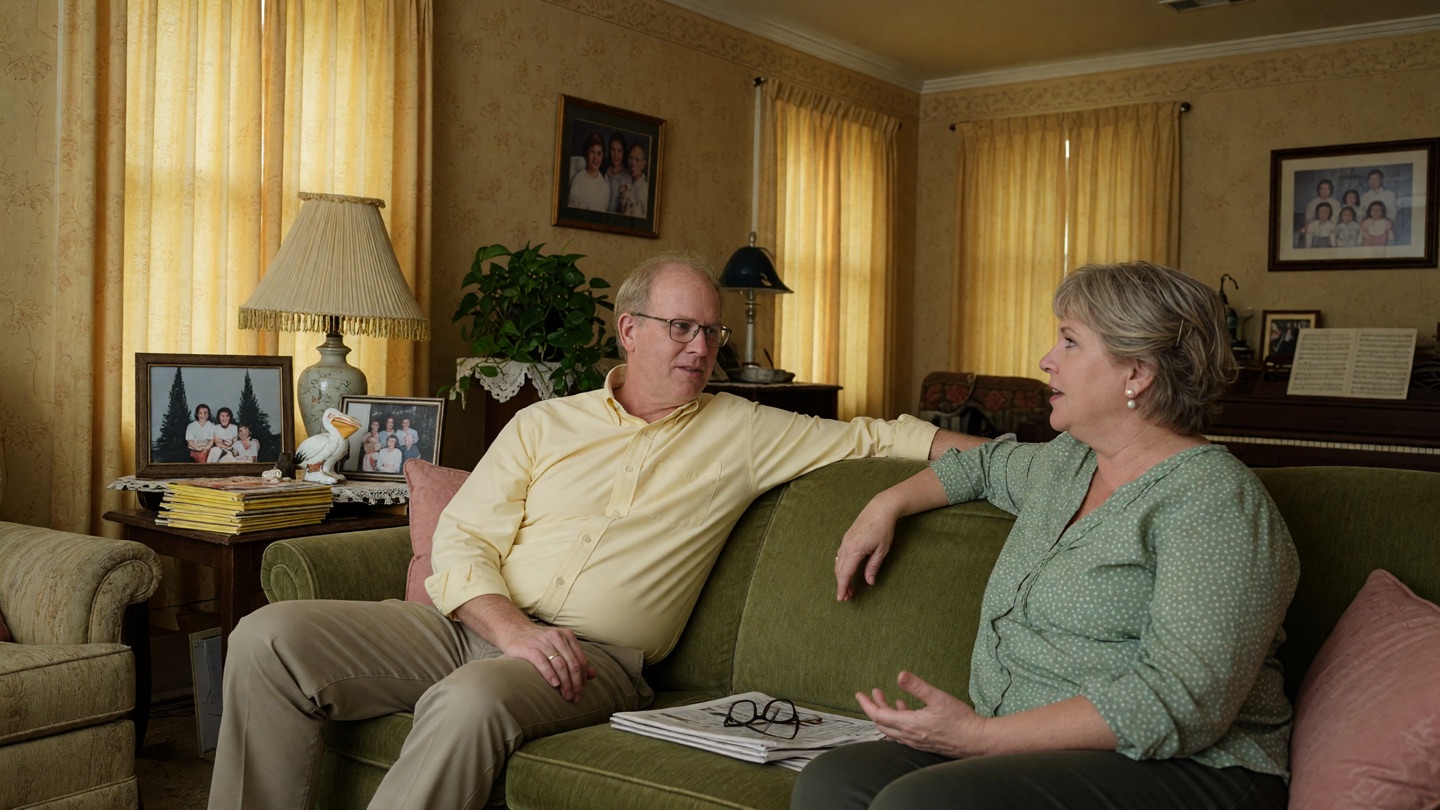
Assisted living usually works when a parent has mild memory loss but stays safe and can find their way around. A secured memory care setting is needed when wandering, exit-seeking, or 24-hour safety needs take over. In Louisiana, memory care is a secured dementia unit inside assisted living, not a separate license. As of 2025, it costs a little more (CareScout 2025 Cost of Care Survey).
If your parent has dementia and you are trying to decide between assisted living and memory care, you are facing one of the harder calls a family makes, and there is no shame in not knowing the answer. This page draws the line for you: what each one is, when standard assisted living is enough, when a secured setting is truly needed, and how memory care actually works here in Louisiana.
What is the difference between assisted living and memory care?
Assisted living is a residential setting where your parent gets meals, help with daily tasks, and medication reminders while keeping a good deal of independence. Memory care is a secured, dementia-focused version of that same setting: locked to prevent wandering, staffed around the clock, and run by people trained in dementia. In Louisiana, both live under one license.
They are not two different worlds. Memory care is assisted living plus a secured environment, dementia-trained staff, closer supervision, and a calmer, more structured daily routine built for memory loss. That is why a parent with early memory loss who is still safe often does well in standard assisted living. The move to a secured setting is driven by safety, not by the diagnosis by itself.
How do assisted living and memory care compare in Louisiana?
Both are licensed the same way in Louisiana, as an Adult Residential Care Provider, or ARCP. The real differences are in security, supervision, staff training, and cost. The table below sets standard assisted living next to a secured memory care unit so you can see, at a glance, which one fits what your parent needs today.
| What to compare | Standard assisted living | Secured memory care |
|---|---|---|
| Best for | A parent who needs help with daily tasks but is still safe and oriented | A parent with dementia who wanders, exit-seeks, or needs constant supervision |
| Setting | An open community where residents come and go | A secured setting, sometimes called a locked unit, to prevent wandering |
| Supervision | Help when needed, not constant watching | 24-hour supervision and monitoring |
| Staff | Trained in personal care and daily help | Trained specifically in dementia care |
| Daily life | General activities and social life | A structured, calming routine and activities designed for memory loss |
| Louisiana licensing | Adult Residential Care Provider (ARCP), LAC Title 48 Part I Chapter 68 | An Alzheimer's Special Care Unit inside an ARCP or a nursing home, same license, extra disclosure required |
| Typical cost (2025) | About $5,163/month (private one-bedroom) | Estimated $5,500 to $6,500/month, roughly $750 to $1,175 more |
| Does Louisiana Medicaid pay? | No for room and board (private pay) | No for room and board when inside an ARCP (private pay); covered inside a nursing home if eligible |
Costs are Louisiana figures from the CareScout 2025 Cost of Care Survey (released 2026) and from LA figures consolidated by Brevy Care. Memory care is not surveyed as its own category, so its number is an estimate, not a quote. Prices vary by parish and by community.
When is assisted living enough for my parent?
Standard assisted living is often enough when your parent has mild memory loss but is still safe: they know where they are, do not try to leave or wander, can follow a daily routine with reminders, and mainly need help with tasks like bathing, dressing, and medications. Many people with early dementia live well in regular assisted living.
Signs that standard assisted living may be the right fit right now:
- They can find their way around a building and do not get lost or try to leave.
- They are not wandering or looking for an exit, day or night.
- They can follow a daily routine with gentle reminders.
- They mainly need help with daily tasks, not someone watching over them constantly.
- They are safe on their own for stretches of the day.
- Their mood and behavior stay steady in a normal, open setting.
A dementia diagnosis on its own does not mean your parent needs memory care. Many Louisiana assisted living communities care well for early memory loss. What matters is whether your parent is safe in an open setting, not the label on the chart.
When does my parent need secured memory care?
Move toward secured memory care when safety is the problem: your parent wanders or tries to leave, gets lost in familiar places, needs someone watching around the clock, or does things that put them at risk. About 6 in 10 people living with dementia will wander at least once (Alzheimer's Association), and a single serious episode is often the deciding moment.
Signs it may be time for a secured setting:
- Wandering or exit-seeking, trying to leave the building or the yard, especially at night.
- Getting lost in places they know well, or not recognizing home.
- Needing 24-hour supervision to stay safe.
- Unsafe actions, like leaving the stove on, letting strangers in, or taking the wrong medication doses.
- Distress, agitation, or fear in an open, unstructured setting.
- A fall, a fire scare, or a wandering episode that frightened everyone, a common tipping point.
- A standard assisted living telling you it can no longer safely meet your parent's needs.
The Alzheimer's Association notes early warning signs that wandering may be coming: coming home late from usual walks or drives, wanting to "go home" when they are already home, pacing or restlessness, and asking about old obligations like getting to work. Most people who wander are found within about 1.5 miles of where they went missing (Alzheimer's Association), but the risk is real, and a secured setting is designed to remove it before something goes wrong.
How is memory care set up in Louisiana?
In Louisiana, memory care is not a separate license or a separate kind of building. It is a secured dementia unit, called an Alzheimer's Special Care Unit, inside an assisted living (an ARCP) or a nursing home. Any community that markets a dementia or Alzheimer's unit must file a state disclosure form describing exactly how it cares for residents.
Because it is the same license, a move to memory care is often a move into a secured wing of the same or a similar community, not a leap into an entirely different world. That can make the change gentler for your parent and for you.
Your best tool on any tour is that state form, the Alzheimer's Special Care Disclosure. By law it must describe the unit's care philosophy, who it will admit and when it must transfer or discharge a resident, how it assesses each person, staff training, the physical layout and safety features, the daily activities, and the fees (ALFBoss; Louisiana Department of Health, ARCP codified rules, LAC Title 48 Part I Chapter 68). Ask to see it every time. It tells you plainly what the unit is set up to handle, and it warns you in advance about the point where your parent might have to move again.
What if my parent needs both memory care and a nursing home?
If your parent has advanced dementia together with heavy medical needs that call for around-the-clock skilled nursing, the right setting may be a secured memory care unit inside a nursing home rather than one inside an assisted living. An ARCP is a residential setting, not a medical one, so it cannot provide the full-time nursing a nursing home can.
The decision is really two questions at once: how much supervision does your parent need, and how much medical care? A nursing home with a secured dementia unit answers both. This is also the one setting where Louisiana Medicaid reliably helps pay the room, board, and care for those who meet income, asset, and care-level rules, unlike an ARCP, where room and board is private pay. Your parent's doctor or a Louisiana advisor can help you tell which line your parent is on.
How a Louisiana advisor helps
Making this call while you are worried about a parent is heavy, and you do not have to carry it alone. A Louisiana senior advisor can help you read what you are seeing, weigh whether more in-home help or adult day care could keep your parent safely at home a while longer, and, when a secured community is the right answer, point you to good ones near you, by parish. A community is only one possible outcome, and buying safe time at home is just as valid a plan.
Families pay nothing for this help. You work with one advisor, and your family is never sold or handed to a list of companies. For dementia questions any time of day, the Alzheimer's Association Louisiana runs a free, confidential 24/7 Helpline at 800-272-3900, serving all 64 parishes, and in the Baton Rouge area (East Baton Rouge Parish), Alzheimer's Services of the Capital Area runs Charlie's Place, an adult day and respite center. When you want a calm second set of eyes, reach out, with no pressure and no obligation to move anyone.
This article is general education, not medical advice, and it cannot decide what any one person needs. Figures are medians and estimates that vary by parish, community, and year. Only a licensed clinician can evaluate your parent's needs. Do not start, stop, or change any care based on this article. Talk with your loved one's doctor.
Common questions
What is the difference between assisted living and memory care?
Assisted living is a residential setting where your parent gets meals, help with daily tasks, and medication reminders while keeping their independence. Memory care is a secured, dementia-focused version of that setting: locked to prevent wandering, staffed around the clock, and run by people trained in dementia. In Louisiana, both fall under one license.
When should someone with dementia move to memory care?
The move is usually driven by safety, not by the diagnosis alone. Consider secured memory care when your parent wanders or tries to leave, gets lost in familiar places, needs someone watching around the clock, or does things that put them at risk. A single serious wandering or safety episode is often the deciding moment.
Is memory care a separate license in Louisiana?
No. Louisiana has no standalone memory-care license. Memory care is a secured dementia unit, called an Alzheimer's Special Care Unit, inside an assisted living (an ARCP) or a nursing home. Any community marketing a dementia unit must file a state disclosure form describing its staffing, training, safety, and admission and discharge rules.
Does Louisiana Medicaid pay for memory care?
Not for room and board. Because memory care usually sits inside an assisted living (an ARCP), and Louisiana Medicaid does not pay ARCP room and board, standard memory care is private pay. When memory care is inside a nursing home, Louisiana Medicaid can help pay for those who meet income, asset, and care-level rules.
How much more does memory care cost than assisted living in Louisiana?
As of 2025, assisted living in Louisiana averages about $5,163 a month for a private one-bedroom. Memory care has no single surveyed price, but estimates put it roughly $750 to $1,175 higher, about $5,500 to $6,500 a month. Costs vary widely by parish and by community, so treat these as a starting point.
Common questions
What is the difference between assisted living and memory care?
Assisted living is a residential setting where your parent gets meals, help with daily tasks, and medication reminders while keeping their independence. Memory care is a secured, dementia-focused version of that setting: locked to prevent wandering, staffed around the clock, and run by people trained in dementia. In Louisiana, both fall under one license.
When should someone with dementia move to memory care?
The move is usually driven by safety, not by the diagnosis alone. Consider secured memory care when your parent wanders or tries to leave, gets lost in familiar places, needs someone watching around the clock, or does things that put them at risk. A single serious wandering or safety episode is often the deciding moment.
Is memory care a separate license in Louisiana?
No. Louisiana has no standalone memory-care license. Memory care is a secured dementia unit, called an Alzheimer's Special Care Unit, inside an assisted living (an ARCP) or a nursing home. Any community marketing a dementia unit must file a state disclosure form describing its staffing, training, safety, and admission and discharge rules.
Does Louisiana Medicaid pay for memory care?
Not for room and board. Because memory care usually sits inside an assisted living (an ARCP), and Louisiana Medicaid does not pay ARCP room and board, standard memory care is private pay. When memory care is inside a nursing home, Louisiana Medicaid can help pay for those who meet income, asset, and care-level rules.
How much more does memory care cost than assisted living in Louisiana?
As of 2025, assisted living in Louisiana averages about $5,163 a month for a private one-bedroom. Memory care has no single surveyed price, but estimates put it roughly $750 to $1,175 higher, about $5,500 to $6,500 a month. Costs vary widely by parish and by community, so treat these as a starting point.
Where this comes from
- Alzheimer's Association: Wandering (6 in 10 statistic, warning signs, most found within 1.5 miles)
- Alzheimer's Association: Alzheimer's Disease Facts and Figures (2025)
- Brevy Care: Memory Care in Louisiana (2026): Rules and Cost (no standalone license, ASCU disclosure, estimate range)
- Brevy Care: Assisted Living in Louisiana (2026): Cost and Levels (ARCP four levels, room-and-board exclusion)
- Brevy Care: Cost of Senior Care in Louisiana (2026), consolidated CareScout 2025 Louisiana medians
- CareScout 2025 Cost of Care Survey (national methodology and state figures; data released 2026)
- Louisiana Department of Health: Adult Residential Care Provider (ARCP) program page
- Louisiana Department of Health: ARCP codified rules, LAC Title 48 Part I Chapter 68 (Jan 2023)
- ALFBoss: Specialized Dementia Care Programs and Alzheimer's Special Care Unit disclosure requirements
- Alzheimer's Association Louisiana Chapter (24/7 Helpline, all 64 parishes)
- Alzheimer's Services of the Capital Area (Baton Rouge, Charlie's Place respite)